
Andrew Jackson at the Hermitage
This Portrait by Earl was presented in 1944 by Mrs. Charles W. Frear of Troy, N. Y., in memory of her husband, who owned it for many years.
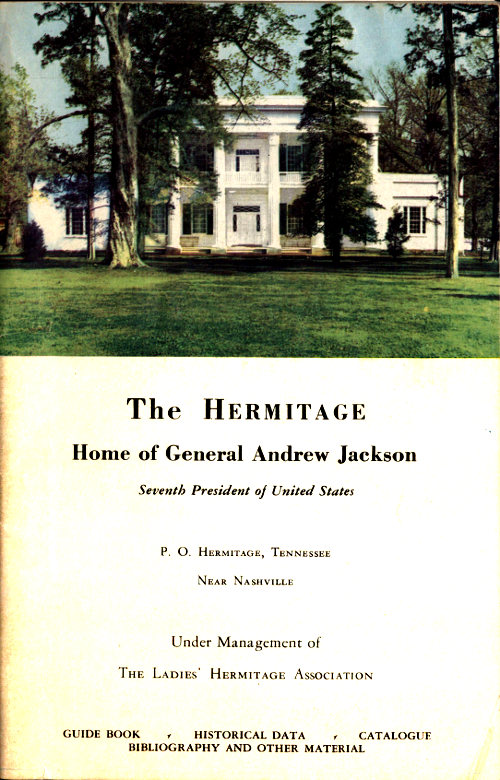
The Hermitage
Home of General Andrew Jackson
Registered National Historic Landmark
Seventh President of United States
P. O. HERMITAGE, TENN.
Originally Compiled by Mrs. Mary C. Dorris
Revised June, 1963
Mrs. A. MacDowell Smith, Regent
Mrs. Horatio B. Buntin, Secretary
Mrs. Douglas M. Wright, Research
- Historical Page 3
- Original Log Hermitage Page 16
- Museum Page 24
- Mansion and Grounds Page 41
- Tomb Page 54
Advice to Andrew Jackson by His Mother
In 1781 Andrew Jackson, then fourteen years of age, enlisted inthe American Army; was captured and thrown into prison, wherehe had smallpox. His mother, Elizabeth Hutchinson Jackson, throughexchange, arranged for his release and nursed him back to health.Responding to an urgent appeal, she left him to go to Charleston tonurse some sick neighbors who were confined there on a British hospitalship. This errand of mercy cost her life. She caught yellow feverand died.
Almost her last words to her young son were:
Andrew, if I should not see you again, I wish you to rememberand treasure up some things I have already said to you. In thisworld you will have to make your own way. To do that, youmust have friends. You can make friends by being honest, andyou can keep them by being steadfast. You must keep in mindthat friends worth having will in the long run expect as muchfrom you as they give to you. To forget an obligation or to beungrateful for a kindness is a base crime—not merely a faultor a sin, but an actual crime. Men guilty of it sooner or latermust suffer the penalty. In personal conduct be always politebut never obsequious. None will respect you more than yourespect yourself. Avoid quarrels as long as you can withoutyielding to imposition. But sustain your manhood always.Never bring a suit in law for assault and battery or for defamation.The law affords no remedy for such outrages that can satisfythe feelings of a true man. Never wound the feelings of others.Never brook wanton outrage upon your own feelings. If everyou have to vindicate your feelings or defend your honor, do itcalmly. If angry at first, wait until your wrath cools before youproceed.
These words were repeated by General Jackson on his birthday,March 15, 1815, at New Orleans, to three members of his militaryfamily: Major John H. Eaton, Major William B. Lewis, and CaptainW. O. Butler. “Gentlemen,” said General Jackson, “I wish she couldhave lived to see this day. There never was a woman like her. Shewas gentle as a dove and as brave as a lioness. Her last words havebeen the law of m